Monday, October 29, 2012

“Pride and Prejudice”


http://mundomystico.com/images/pride-and-prejudice.jpg
This week he have being seeing “Pride and Prejudice”, is a novel by Jane Austen. The story follows the main character Elizabeth Bennet as she deals with issues of manners, upbringing, morality, education, and marriage in the society of the landed gentry of early 19th-century England.

The fight of Elizabeth against the social rules, and the complications of love makes this novel very intriguing and interesting. Charles Bingley best friend, Mr. Darcy an arrogant and obnoxious person, how told him that Elizabeth wasn’t a woman good enough for Charles, get’s in love with the only person that wasn’t “good enough” for a marriage and everything went crazy. Mr. Darcy finds himself increasingly attracted to Elizabeth’s charm and intelligence. And a not corresponded love begins.
http://profile.ak.fbcdn.net/hprofile-ak-prn1/50512_172577049426146_8174464_n.jpg 
This novel helps us understand the idea of an alienated character. This is a character that is different from his reality and it can be seen at the book we just read: “To Kill a Mockingbird”, where Boo Radley is an alienated character as Elizabeth is.


Clip Analysis Questions

1. Why do you think "Pride and Prejudice" continues to be a referent for modern tales?

Pride and Prejudice is still a referent for modern tales because it deals with huge issues like: not corresponded love and the use of alienated characters. This combination of factors makes an ideal love novel.


2. What do you think is the effect that these different authors (film directors, producers, modern writers) want to achieve in today's audiences?

The idea of the different film directors or authors is to give the story, their own style. This makes every movie rich in ideas, and unique. The zombie version of Pride and Prejudice, is  a different version of the story but it has the same base of all of them (the base of the story).


3. If you had to choose one of the previous versions to analyse, which would be the one and why?

I'll have chosen the Pride and Prejudice of 2005, because It seems like a movie with an excellent setting and better staging. Also it seems is the version that conserves better the plot of the movie. 


Sunday, October 28, 2012

Remembering P-E-E structure


The PEE Structure is a way of expressing an idea, clearly and with evidence. This is conformed from the Point, the Evidence and the Explanation.
Point: 

Chapter 1 Analysis


1-.What characters are introduced in this chapter?
There are many characters introduced in this chapter. First we’ve got Gerg Koves, how is the protagonist and the one how tells the story. Second we have other important characters such as Mr. Suto (how is an employee of the family), Stepmother and Uncle Willie. Then we’ve got other characters like Annemarie, Andrew Lajos, etc…

2-. Choose two characters and select a quote to describe them physically or phychologically.
Mr. Suto: “Yellowish red light-spots were dancing like bursting pustules all over his round, brownish-skinned features, with the pencil moustache and the tiny gap between his two broad, while front teeth.”
Georg: “Being a big boy, now in my  fifteenth year(…)”

3-. What is the narrative technique?
Point of View: Narrator in first person. (“now in my fifteenth year”)
Narrator: Indirect he doesn’t approaches to the reader. (“It occurred to my stepmother that she had forgotten to redeem the bread aoupon.”)
Speech: Reported. (“It occurred to my stepmother that she had forgotten to redeem the bread aoupon.”)
Tense: past tense (“I didn’t go to school today”)

4-. Describe the setting of this chapter.
Budapest at the Second World War, Jewish normal life is affected because of the invation of Germany.

Fatelessness Chapter 3 Quotes + video


Here I have some important quotes of the third chapter of Fatelessness, these quotes are very interesting because the express different ideas on the book. Also this exercise will be very interesting because I will review the PEE Structure.
1-. The idea of concentration camps was something unknown for the Jewish population. They were eager to figure out what was going on. “The attempted mainly to figure out what consequences the episode might have for them; from what I could hear, thought, there were about as many different views as there were men”. This quote is said by the protagonist as he observes a group of grown up Jewish workers, that gathered together to discuss about the police actions of stopping them wail going to work. The meaning of this quote is that people didn’t know what to do when policemen stop their buses.
2-. The idea of Nazi superiority is expressed in the book, where Jewish population is segregated, in a way of racism. “He turned toward the gendarmes, ordering them, in a bellow that filled the entire square, to take the whole Jewish rabble off to the place”. This quote is said by the protagonist of the story, when he is entering the “labor camps” for first time. The meaning of this quote is that Jewish are an inferior group, that should be commanded by the Nazis.
3-. Georg was astonish when he first enter the labor camp, and he realize that it was worse than he thought they were. “ They led us on into a maze of gray buildings, before we suddenly debouche onto a huge open space strew with a white gravel”.  This clearly represents the protagonist feeling of fear, because of it’s unknown reality.

“Seven pillars of Judaism”


As we are studying Second World War, we are learning more about the Jewish culture and their traditions, so our professor told us about the “seven pillars of Judaism”. They are the seven more important traditions of their culture, and they are essential to understand and study their culture. Here is a brief overview of them:

Mezuzah: It is a piece of parchment inscribed with specified Hebrew verses. A mezuzah is affixed to the doorframe in Jewish homes to fulfill the mitzvah (Biblical commandment) to inscribe the words of the Shema "on the doorposts of your house". 
Tefillin: Are a set of small black leather boxes containing scrolls of parchment inscribed with verses from the Torah, which are worn by observant Jews during weekday morning prayers. The Torah commands that they should be worn to serve as a "sign" and "remembrance" that God brought the children of Israel out of Egypt.

Shofar: is a Jewish instrument most often made from a ram’s horn, It was used to announce the start of holidays, in processions and even to mark the start of a war. Perhaps the most famous biblical reference to the shofar occurs in the Book of Joshua, where shofarot (plural of shofar) were used as part of a battle plan to capture the city of Jericho:

Tzedakah: literally means righteousness, but it is often interpreted as charity, because Judaism views giving as the ultimate act of righteousness. Whether it is teaching a skill, donating goods, or giving money, tzedakah is an integral part of living a Jewish life and is in fact required of all Jews.

Hanukkah: also known as the Festival of Lights, is an eight-day Jewish holiday, starting on the 25th day of Kislev according to the Hebrew calendar, which may occur at any time from late November to late December in the Gregorian calendar. The festival is observed by the kindling of the lights of a unique candelabrum (Menorah) one additional light on each night of the holiday, progressing to eight on the final night. 

Kosher foods are those that that may be consumed according to halakha (Jewish law) is termed kosher in English, meaning "fit" (in this context, fit for consumption). A list of some kosher foods is found in the book of Leviticus, as are also certain kosher rules. Reasons for food not being kosher include the presence of ingredients derived from nonkosher animals.

Sabbath is generally a weekly day of rest or time of worship observed in Abrahamic religions and other practices. Many viewpoints and definitions have arisen over the millennia. The term has been used to describe a similar weekly observance in any of several other traditions; the new moon; any of seven annual festivals in Judaism and some Christian traditions; any of eight annual paganfestivals (usually "sabbat"); an annual secular holiday; and a year of rest in religious or secular usage, originally every seventh year.


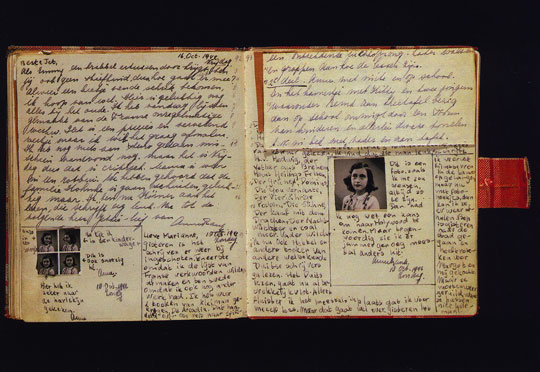
Ana Frank's Diary


As this period  we are reading “Fatelessness”, we are exploring the historical context of this novel; the Second World War. This global war, is distinguished by  the genocide of the Jewish population, and their suffering at the concentration camps. People were tortured and kill with now reason, and some of them, wrote their experiences at their own diaries. This is the case of Ana Frank’s Diary.

This diary, can be compared to Imre Kertesz’s novel “Fatelessness”, because is also a written  document of the experiences the author suffered from the German invasion.

 Her diary has been the basis for several plays and films. It gain fame because of its accuracy and well-written record of their time in hiding. She wrote it while She was hided in a little apartment in Frankfurt am main, with her parents and sister. They staid there until de German police, specifically the Gestapo found their hiding in August 1944.
 

When Second World War ended, the diary was found and published by a familiar of her family, being now days recognized as one of the more important books of the war.

Holocaust Timeline


This term, we are reading the book "Fatelessness", a text that deals with the racist ideals of the Nazi party. This book takes place on Budapest at the Second World War, were Germany invade other countries for territorial power. That’s why I decided to make this timeline as a summary of what was going on in Europe, determining the setting of the novel we are reading.

This is my historical timeline: Holocaust Timeline